Bigraphs and Bigraphical Reactive Systems are a graphical calculus for describing the syntax and semantics of systems in terms of two orthogonal notions: connectivity and locality. They have also been applied successfully in other fields, such as knowledge representation. Robin Milner and colleagues proposed bigraphs in 2000, and they have been under development ever since. For an introduction, see Milner’s book The Space and Motion of Communicating Agents or bigraph.org.
jLibBig implements bigraphical reactive systems. It also provides tools and infrastructure for extending them, and for implementing new flavours of bigraphs for a wider range of scenarios.
Part of this extensibility comes from attached properties, which extend the structure of a bigraph dynamically by attaching (possibly mutable) attributes, for example to nodes. Properties can store concrete values such as IP addresses or user permissions without encoding them in the bigraphical language. Matching and rewriting can be customised to take properties into account.
A first example
The following program defines a signature with a single control Printer with
two ports, and builds the bigraph pictured below.
import it.uniud.mads.jlibbig.core.std.*;

public class SimpleBig {
    public static void main(String[] args) {
        SignatureBuilder signatureBuilder = new SignatureBuilder();
        signatureBuilder.add(new Control("Printer", true, 2));
        Signature signature = signatureBuilder.makeSignature();

        BigraphBuilder builder = new BigraphBuilder(signature);
        OuterName spooler = builder.addOuterName("Spooler");
        OuterName network = builder.addOuterName("Network");
        Root root = builder.addRoot();
        Node printer = builder.addNode("Printer", root, spooler, network);
        builder.addSite(root);
        builder.addSite(printer);
        builder.addInnerName("Network", network);
        Bigraph bigraph = builder.makeBigraph();

        System.out.println(bigraph);
    }
}
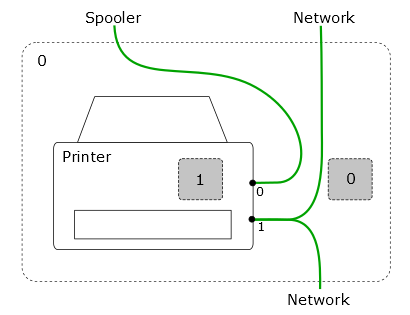
Attached properties add extra information at run time:
printer.attachProperty(new ProtectedProperty<String>("NETWORK_ALIAS", "Lab printer"));
Paper format = printer.<Paper>getProperty("DEFAULT_FORMAT").get();
printer.<Paper>getProperty("DEFAULT_FORMAT").set(Paper.A4);
Matchers can be customised as well, for example to consider only access points within range, or to compute optimal (weighted) matches:
Matcher matcher = new WeightedMatcher() {
    protected int matchingWeight(Bigraph agent, Node nodeAgent, Bigraph redex, Node nodeRedex) {
        if (nodeAgent.getControl().equals(AP_C) && nodeRedex.getControl().equals(AP_C))
            return getDistance(nodeAgent);
        return super.matchingWeight(agent, nodeAgent, redex, nodeRedex);
    }
};
Modules
- Core: the main infrastructure, the abstractions shared by bigraphs and
their extensions, and a default implementation of BRS with abstract names.
The
ldbpackage implements directed bigraphs. Ordinary and weighted matches are solved as constraint satisfaction problems with the Choco solver. - BigMC interoperability: import and export utilities for the text format of the BigMC model checker.
- UDLang: tools for UDLang, a text format for encoding bigraphical reactive systems.
Source code, releases and documentation are on GitHub.